
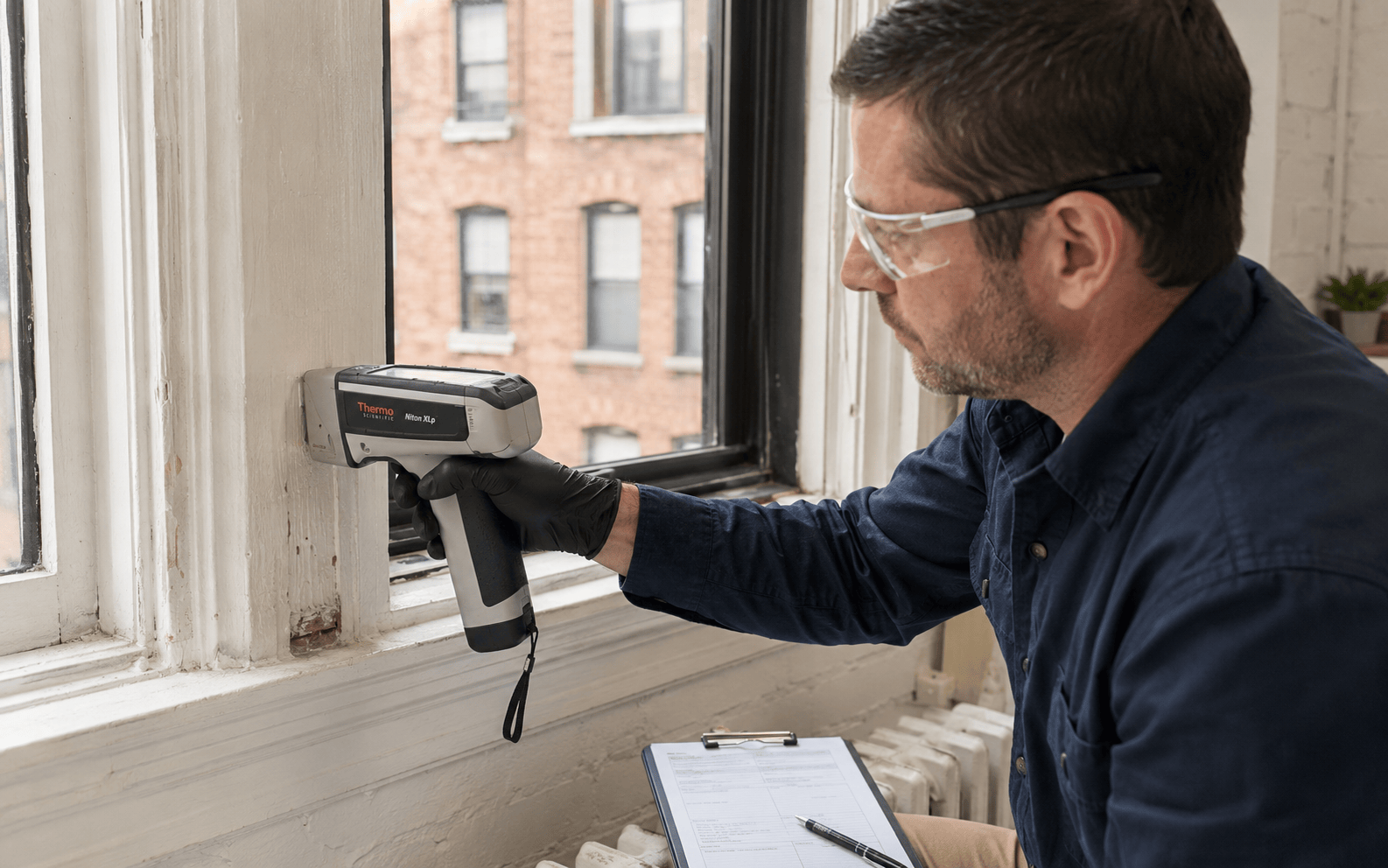
What makes the Niton XLp family distinctive
Thermo Scientific Niton is one of the best-known names in portable XRF. For many inspectors, the Niton XLp family represents an established generation of lead paint field equipment: pistol-grip analyzer, component-by-component readings, instrument checks, and reports that connect each reading to a room and surface. That familiarity is useful because building owners, consultants, and environmental professionals may already recognize the platform. For local help, our team can help you sort out the next step.
The strength of a Niton-style workflow is its history in environmental field testing. Many firms built their lead paint procedures around Niton instruments and similar handheld XRF analyzers. For owners, that history can be reassuring, but it should not be treated as automatic proof of compliance. The actual unit, software configuration, calibration or standardization practice, service history, and inspector training still matter.
Popular Niton model names owners may hear
- Niton XLp: a legacy handheld XRF family often associated with lead paint and environmental inspection conversations.
- Niton XL2: a later handheld platform used broadly in field elemental analysis, including environmental and materials applications depending on configuration.
- Niton XL3t: a higher-capability handheld platform often discussed for broader XRF applications where enhanced performance and software options are relevant.
- Niton XL5 Plus: a newer, compact-generation Niton platform used in portable elemental analysis workflows.
How Niton compares with Vanta and SciAps
| Compared with | Typical difference | Practical implication |
|---|---|---|
| Evident Vanta | Niton has stronger legacy recognition in many lead paint circles; Vanta is often discussed as a rugged modern industrial XRF platform. | A Niton report may feel familiar to older environmental teams, while a Vanta workflow should be reviewed for lead-specific setup and documentation. |
| SciAps X-Series | Niton represents a mature installed base; SciAps is commonly presented as a newer-generation portable XRF line with lead-focused configurations. | Owners should compare field documentation, speed, service support, and protocol fit rather than relying on age or brand recognition alone. |
Where Niton-style equipment fits in NYC buildings
Niton-style handheld XRF equipment can be useful in older New York housing because painted components are numerous and varied. A single apartment may contain painted wood windows, metal radiators, plaster walls, built-in shelving, door casings, baseboards, and repair patches. A practical inspection method must let the inspector move through those components without destroying finishes unnecessarily.
The challenge is not simply collecting readings. It is keeping the data organized. Unit numbers, room names, component names, substrates, and access notes must be consistent. This is especially important in rent-regulated portfolios, co-ops, multi-building assignments, and projects where records may be reviewed long after the field visit. A related guide on this site covers XRF Analyzers for NYC Lead Paint Inspections. Another useful page explains What Is a Mandatory Apartment Inspection or Laser Test in NYC?.
Questions owners should ask about a Niton report
Owners should ask which specific Niton unit was used, whether the device was appropriate for the scope, whether the inspector performed and recorded required quality checks, and whether the report shows the model and serial number. They should also ask how the firm handles inconclusive readings, substrate corrections, inaccessible components, and report revisions. Federal background is available in EPA inspection guidance.
A strong report should not say only that “an XRF was used.” It should show how the device was used, where it was used, who used it, when quality checks were performed, and how the results support the owner’s compliance or planning objective. Additional background is available from OSHA lead safety page.
Bottom line
The Niton XLp name is useful shorthand for an established XRF inspection approach, but owners should evaluate the entire inspection system. Equipment, certification, radiation safety procedures, field SOPs, report review, and record retention all determine whether the final document is useful.
Scheduling access in NYC buildings
NYC LeadSafe Experts plans inspections around unit access, owner records, and report usability. For Niton-style workflows, that means testing is scheduled so the inspector can move systematically through rooms and components, reducing missed areas and producing records that can be interpreted later.